
Introduction
Additive manufacturing makes it possible to produce functional parts quickly, but speed alone does not guarantee reliability. Many functional components fail during testing or early use because potential weaknesses were never evaluated before printing. Once a part is printed, identifying the root cause of failure often requires multiple redesigns and reprints.
Simulation addresses this challenge by allowing engineers to evaluate part behavior before material is consumed. In additive manufacturing, where material anisotropy and process-related variability influence performance, simulation becomes a critical validation step rather than an optional extra.
At Mechtrai 3D Services, simulation is integrated into the development workflow to ensure that functional parts are engineered to perform reliably before they are printed.
Understanding Performance Before Physical Testing
Physical testing provides valuable data, but relying solely on printed prototypes to discover design weaknesses is inefficient. Without prior insight, testing often reveals that a part fails—but not why it fails.
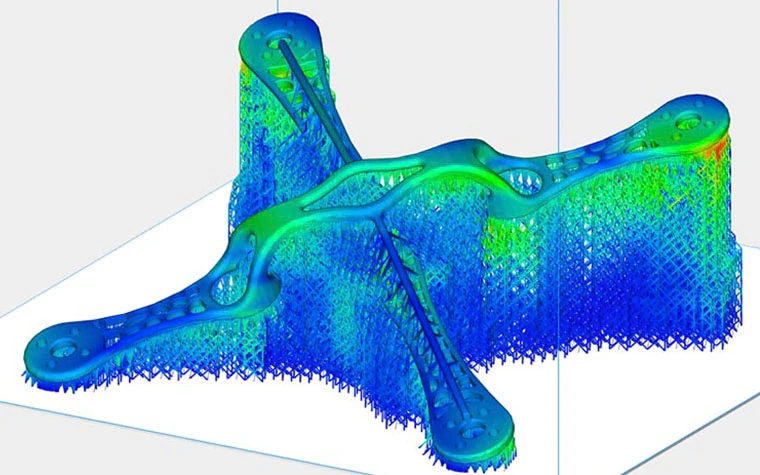
Engineering simulation, particularly finite element analysis (FEA), helps predict how a component will respond to real-world loads and constraints. By evaluating stress distribution, deformation, and stiffness digitally, engineers gain clarity on whether a design can meet functional requirements before committing to production.
This early understanding allows teams to make informed design decisions rather than reacting to failures after they occur.
Reducing Trial and Error in Prototyping
Trial-and-error prototyping is one of the most common sources of wasted time and material in product development. Reprinting parts multiple times to resolve unexpected failures increases cost and extends development timelines.
Simulation reduces this uncertainty by identifying critical areas that require reinforcement or redesign. Design changes can be evaluated quickly in the digital environment, enabling optimized solutions to be printed with higher confidence.
By reducing the number of physical iterations required, simulation helps teams move faster while maintaining engineering rigor.
Accounting for Additive Manufacturing Behavior
Additively manufactured parts behave differently from conventionally manufactured components. Layer-by-layer construction introduces anisotropy, making strength and stiffness dependent on print orientation and process parameters.
Simulation allows engineers to consider these effects during validation. When combined with an understanding of printing orientation and material behavior, analysis results become more representative of real-world performance. This ensures that printed parts are validated based on how they will actually be manufactured and used.
Supporting Better Design Decisions
Simulation is not only a validation tool but also a decision-support mechanism. It helps engineers compare design options, evaluate trade-offs between strength and weight, and understand the impact of material or geometry changes.
Rather than relying on conservative overdesign, simulation enables targeted improvements that enhance performance without unnecessary material usage. This leads to more efficient, reliable, and scalable designs.
Integrating Simulation into Product Development
For simulation to deliver maximum value, it must be integrated early in the development process. When treated as a final check, its ability to influence design is limited.
Mechtrai integrates FEA as part of a coordinated workflow that includes CAD design, material selection, and additive manufacturing. Simulation insights directly inform design refinement, ensuring alignment between digital validation and physical production.
Conclusion
Printing functional parts without prior simulation introduces avoidable risk. While additive manufacturing enables rapid production, simulation ensures that speed does not come at the expense of reliability.
By validating designs digitally before printing, engineering teams can reduce failures, minimize rework, and build confidence in product performance. Simulation transforms 3D printing from an experimental process into a predictable, engineering-driven manufacturing method.