
Introduction
Design optimization plays a crucial role in modern product development, especially when performance, efficiency, and manufacturability must be balanced simultaneously. Many components are either overdesigned resulting in unnecessary material usage and cost or underdesigned, leading to failures during testing or use.
Engineering-driven design optimization ensures that components meet performance requirements while remaining efficient and practical to manufacture. Rather than relying on conservative assumptions, optimization uses analysis and engineering judgment to achieve reliable results.
At Mechtrai 3D Services, optimization is treated as a systematic engineering process aligned with validation and manufacturing intent.
Understanding the Role of Optimization
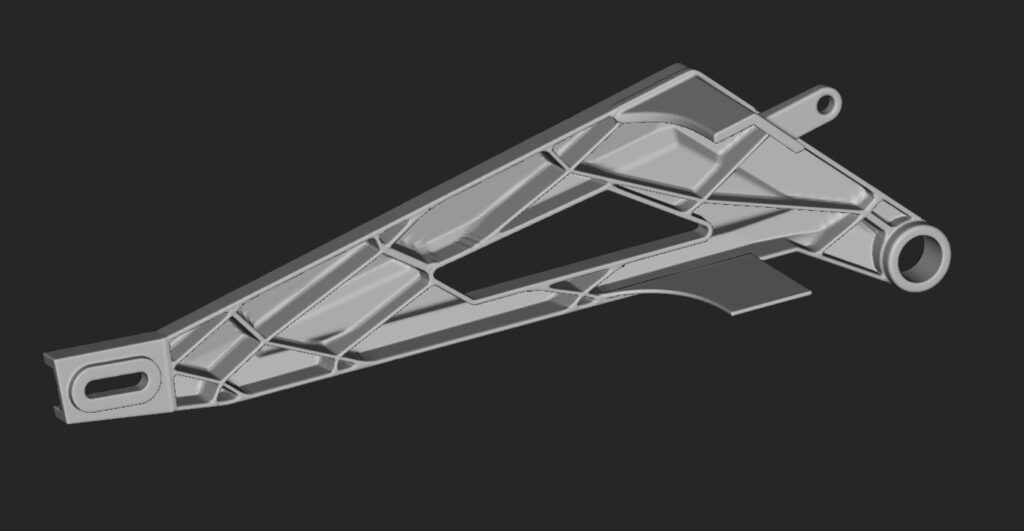
Optimization is not about making parts as light or complex as possible. It is about aligning material distribution with actual load paths and functional requirements. When geometry is shaped by how forces flow through a component, strength and stiffness can be improved without adding unnecessary material.
In additive manufacturing, this approach is particularly effective, as design freedom allows geometry to be adapted for performance rather than constrained by traditional manufacturing methods.
Improving Strength-to-Weight Performance
Strength-to-weight ratio is a critical metric in many applications, especially in mobility, robotics, and industrial systems. Poorly optimized designs often carry excess material in low-stress areas while remaining weak in critical regions.
Engineering optimization identifies these inefficiencies through simulation and analysis. Material can be redistributed to reinforce high-stress zones while reducing mass elsewhere. This leads to parts that are lighter, stronger, and more efficient without compromising reliability.
Optimizing for Manufacturability
Performance alone does not guarantee success. Designs must also be manufacturable consistently and economically. In additive manufacturing, features such as wall thickness, overhangs, and print orientation directly influence print quality and repeatability.
Optimization considers these manufacturing constraints from the outset. By aligning geometry with printing capabilities and material behavior, optimized designs achieve consistent results across multiple builds.
Reducing Cost and Development Time
Optimized designs often require fewer iterations because performance issues are addressed early. Reduced material usage lowers printing costs, while improved reliability minimizes rework and post-processing effort.
By reducing uncertainty, optimization shortens development cycles and supports faster transition from prototype to production.
Integrating Optimization into the Engineering Workflow
Design optimization delivers the greatest value when integrated with CAD design, simulation, and validation. Treating optimization as a separate or late-stage activity limits its effectiveness.
Mechtrai integrates optimization into a coordinated engineering workflow, ensuring that design changes are validated and aligned with real manufacturing conditions.
Conclusion
Design optimization is essential for achieving the right balance between strength, weight, and manufacturability. When driven by engineering analysis rather than assumptions, optimization improves performance, reduces cost, and enhances reliability.
By combining simulation, material understanding, and additive manufacturing expertise, optimized designs become not only efficient but also production-ready.