
Introduction
3D printing often appears complete once a part is removed from the build plate, but for functional applications, printing is only part of the process. Raw printed parts frequently fall short in terms of surface finish, dimensional accuracy, strength, or assembly readiness. Without proper post-processing, even well-designed and well-printed components may fail during testing or real-world use.
Post-processing bridges the gap between printed geometry and functional performance. It transforms raw prints into usable, reliable components that can withstand testing, assembly, and operational demands.
At Mechtrai 3D Services, post-processing is treated as an engineering step rather than a cosmetic afterthought.
Why Printed Parts Often Need Post-Processing
Additive manufacturing produces parts layer by layer, which can result in visible layer lines, support marks, and minor dimensional variations. These characteristics may be acceptable for visual models, but they often limit functional performance.
Issues such as poor surface contact, weak threaded regions, or interference during assembly can arise if parts are used directly after printing. Post-processing addresses these limitations by refining geometry, improving surface quality, and enhancing functional features.
Improving Functional Reliability
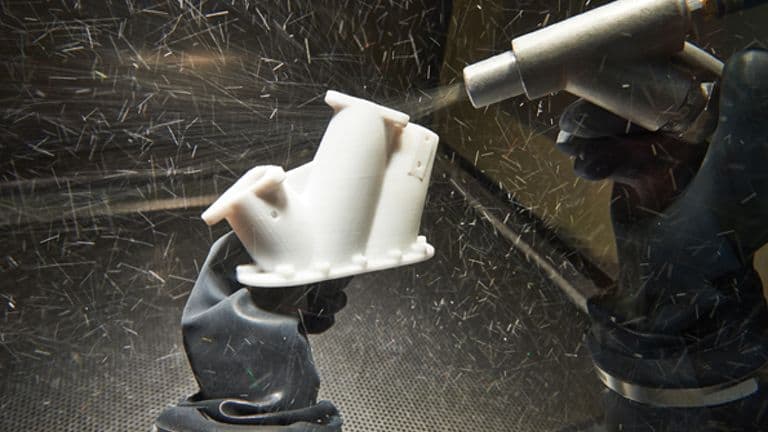
Post-processing plays a critical role in improving the reliability of printed components. Operations such as support removal, sanding, smoothing, and insert installation help ensure that parts perform as intended during use.
For example, installing threaded inserts improves load-bearing capability in fastened joints, while surface finishing reduces stress concentration caused by rough layer transitions. These improvements can significantly extend part life and improve test outcomes.
Dimensional Accuracy and Assembly Fit
Even small dimensional deviations can cause issues during assembly, especially when printed parts interface with machined or molded components. Post-processing helps achieve tighter tolerances and better fit, enabling smoother integration into assemblies.
By addressing dimensional and surface inconsistencies, post-processing ensures that printed parts behave predictably during installation and operation.
Supporting Testing and End-Use Applications
Functional testing often places higher demands on parts than initial inspection suggests. Parts may be subjected to repeated loading, vibration, or environmental exposure. Post-processing prepares components for these conditions by strengthening critical areas and improving surface integrity.
In some cases, basic finishing or strengthening steps determine whether a printed part is suitable for short-term testing, long-term use, or low-volume production.
Integrating Post-Processing into the Workflow
Post-processing is most effective when planned alongside design, material selection, and printing strategy. Treating it as a last-minute activity can introduce variability and rework.
Mechtrai integrates post-processing considerations into the overall engineering workflow, ensuring that printed parts are designed and produced with finishing requirements in mind. This coordinated approach improves consistency and reduces turnaround time.
Conclusion
Printing a part is only the beginning. Without proper post-processing, functional performance, reliability, and usability can be compromised.
By treating post-processing as an essential engineering step, additive manufacturing delivers components that are not only printable but truly usable. When printing and post-processing work together, 3D printed parts are ready for real-world testing and application.