
Introduction
One of the biggest advantages of engineering-led 3D printing is the ability to identify problems before material is consumed. Finite Element Analysis (FEA) plays a key role in this process by predicting how a part will behave under real-world conditions.
Instead of discovering issues after printing, FEA allows engineers to validate designs digitally and make informed decisions early.
Why Problems Often Go Unnoticed
Many 3D printed parts fail at specific locations due to stress concentration, poor load distribution, or insufficient stiffness. These weaknesses are not always visible in the design stage and may only appear when the part is used.
Without analysis, these issues are often discovered through failed prints or broken parts—both of which are costly and time-consuming.
Understanding Part Behavior Before Printing
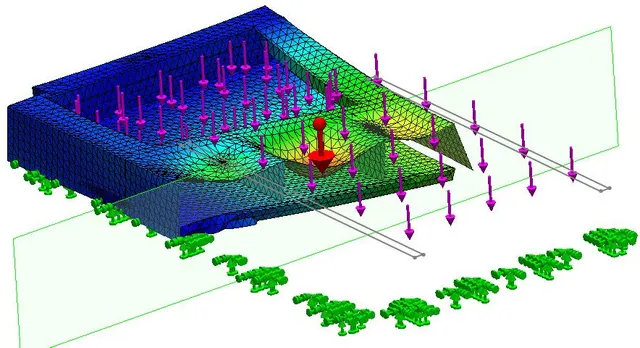
FEA simulates how forces, loads, and constraints act on a part. This helps engineers understand where stresses are highest and which regions require reinforcement or redesign.
By visualizing part behavior early, design decisions are based on data rather than assumptions.
Reducing Iterations and Material Waste
When designs are validated through FEA, fewer physical iterations are required. Changes can be made digitally before committing to printing, saving material, machine time, and effort.
This reduces trial-and-error and leads to faster development cycles.
Aligning Design with Material and Process
FEA also helps align design with material behavior and print orientation. This ensures that the printed part performs as intended when subjected to real loads.
Engineering validation bridges the gap between digital design and physical performance.
Building Confidence Before Production
Before moving to batch printing or production, FEA provides confidence that the part will perform reliably. Risks are identified and addressed early, reducing costly late-stage changes.
Confidence before commitment is a major advantage of simulation-driven workflows.
Conclusion
FEA transforms 3D printing from an experimental process into a predictable engineering solution. By catching problems before printing begins, it reduces failures, saves time, and improves reliability.
Simulation-first thinking leads to better parts and better outcomes.